
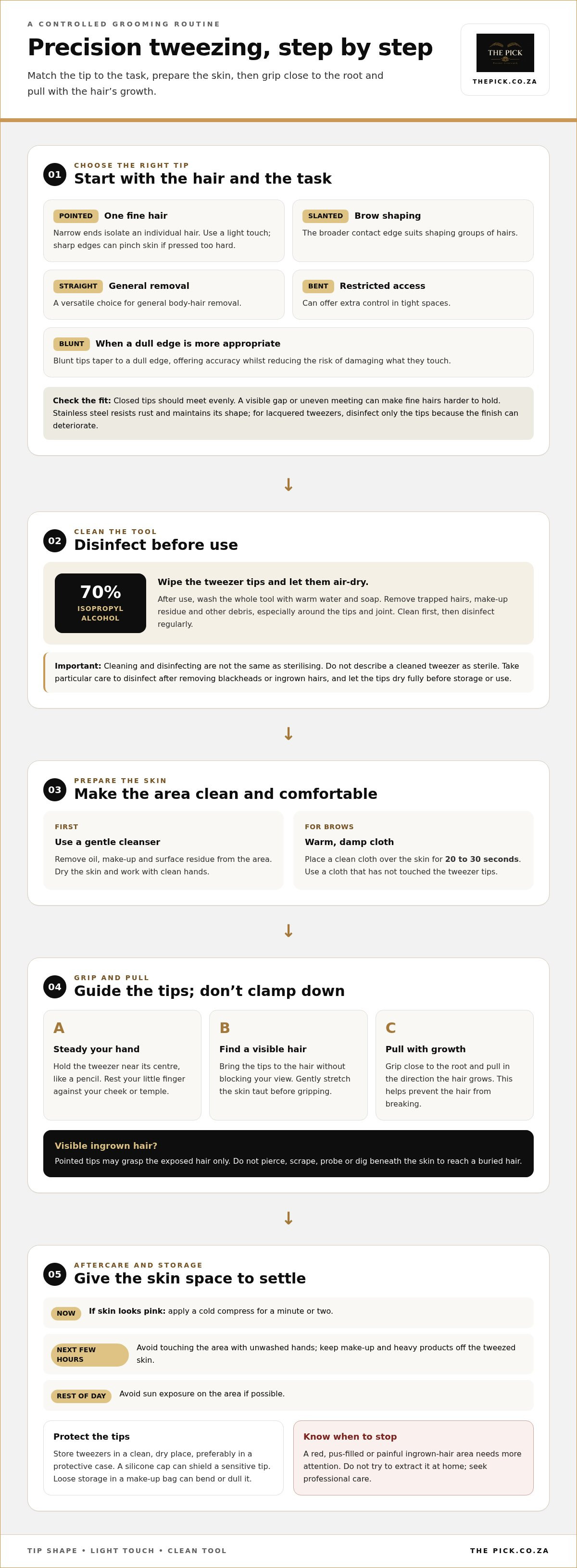
Tip shape, not force, is the starting point for how to use precision tweezers. Pointed tips isolate one hair at a time, slanted tips help shape brows, and straight tips work for general hair removal. Grip close to the root and pull in the direction of growth to help prevent the hair from breaking.
A clean, controlled technique matters, but even careful tweezing can leave skin red or bumpy. Repeated pulling, pinching the skin or an ingrown hair may cause a reaction, and digging beneath the skin can make it worse. This guide explains what precision tweezers are designed to do, how tip shapes suit different tasks, and how to tweeze with more control. You’ll also learn how to care for your tool, what may trigger irritation, and when an ingrown hair needs more than tweezers. The result is a clearer routine, fewer guesswork moments and a better sense of when to stop.
Key Takeaways
- Match the tweezer tip to the task: some shapes target individual hairs, whilst others are better for shaping or handling larger items.
- Clean tweezers and store them carefully to help keep their tips precise and your grooming routine more hygienic.
- Use pointed tweezers gently for visible fine hairs, but don’t dig beneath the skin to reach a buried ingrown hair.
- Red bumps can follow irritation or repeated pulling. Learn what may help calm the skin and when to stop tweezing.
- Precision tweezers serve more than grooming, with specialised designs used in delicate technical and laboratory work.
What are Precision Tweezers?
Precision tweezers are hand tools with shaped tips designed to grip small targets accurately, including individual hairs. Hold them like a pencil and rest your little finger against your cheek or temple to steady your hand.
Matching tip shapes to grooming tasks
Tip shape determines how a tweezer meets a hair, so matching the tip to the task can improve control. Point tips isolate one hair at a time, while slanted tips suit shaping groups of hairs. Straight tips are a versatile choice for general body-hair removal.
Choose pointed tips for a fine stray hair that needs individual attention. Slanted tips provide a broader contact edge for shaping brows. Bent tips can offer extra control in tight spaces. Pointed tips can also reach difficult areas, but their sharp edges can damage material or pinch skin if you press too hard.
Blunt tips taper to a dull edge. They offer accuracy whilst reducing the risk of damaging what they touch. For routine grooming, consider where the hair sits and how much surrounding skin or material the tip may contact. The best fit is the one that grips the target without forcing you to squeeze harder.
Checking tip alignment and steel construction
Aligned tips meet evenly when closed, helping the tweezer grip a hair rather than slide past it. Check the contact points before grooming, as a visible gap or uneven meeting can make fine hairs harder to hold. Sharp, clean points can target small hairs precisely, but they require a light touch and careful handling.
Stainless steel tweezers suit tasks that call for frequent disinfection. Stainless steel resists rust, maintains its shape and supports consistent precision. These qualities matter when the tips need to meet reliably with repeated use. Gold-plated tools follow the same guidance as stainless steel in this context. Lacquered tweezers need different care: disinfect only their tips, since the finish can deteriorate over time.
For better control, grip the tweezer near its centre and hold it as you would a pencil. Rest a little finger on your cheek or temple, then bring the tips to the hair without blocking your view. This steady position helps you guide the points instead of clamping down with force.
To decide which tweezer suits your routine, start with the target. A single fine hair calls for pointed tips; brow shaping often suits slanted tips; general body-hair removal can use straight tips. Choose blunt tips when a dull edge is more appropriate, and bent tips when access is restricted. Tip shape, alignment and material all affect how the tool handles the task.
Why does my skin get red bumps after tweezing?
Red bumps can appear when tweezing irritates the skin around a hair follicle. Pinching, repeated pulling and contaminated tweezer tips can add to the irritation. A pink patch after grooming differs from a painful, pus-filled area, which needs more attention. A clean tool, prepared skin and a light touch help keep the process controlled.
Before each use, wipe the tweezer tips with 70% isopropyl alcohol and let them air-dry. This disinfects the contact points before they touch your skin. After use, wash the whole tool with warm water and soap. Remove trapped hairs, make-up residue and other debris, especially around the tips and the joint. Clean first, then disinfect regularly. This routine is not the same as sterilising a tool, so don't describe a cleaned tweezer as sterile.
Disinfect tweezers particularly carefully after removing blackheads or ingrown hairs. Alcohol or disinfectant detergent can be used; keep the chosen product on the tweezer rather than the surrounding skin. Lacquered tweezers need extra care because their finish can deteriorate: disinfect only the tips. Stainless steel suits tools that need frequent disinfection. Let the tips dry fully before storing or using them.
Prepare the skin with a gentle cleanser to remove oil, make-up and surface residue from the area. For brows, place a clean, warm, damp cloth over the skin for 20 to 30 seconds. The warmth softens the surface and makes the area more comfortable to work on. Use a clean cloth, not one that has already touched the tweezer tips. Then dry the skin and work with clean hands.
After grooming, avoid touching the area with unwashed hands for the next few hours. If the skin looks pink, apply a cold compress for a minute or two. Keep make-up and heavy products off the tweezed skin for a few hours, and avoid sun exposure there for the rest of the day if possible. These steps limit extra contact and irritation while the skin settles.
Store tweezers in a clean, dry place, preferably in a protective case. A silicone cap can shield a sensitive tip, while loose storage in a make-up bag can bend or dull it. Avoid dropping the tool or leaving it exposed to moisture for long periods. If a red, pus-filled or painful ingrown-hair area develops, don't try to extract it at home; seek professional care. For a more controlled grooming routine, explore precision hair-removal tools.
Can tweezing cause ingrown hairs?
Yes. Tweezing can contribute to ingrown hairs if a hair breaks or the follicle becomes irritated. To use precision tweezers correctly, grip a visible hair close to its root, then pull in the direction of growth. Don’t dig beneath the skin to retrieve a buried hair.
Pointed-tip tweezers suit fine hairs because their narrow ends can isolate one target. Hold them like a pencil, steady your hand against your cheek or temple, and approach the hair at an angle. Gently stretch the skin taut before gripping, then pull close to the root. This helps reduce pinching and gives you a clearer line of control.
For a visible ingrown hair, use pointed tips only to grasp the exposed hair. Don’t pierce, scrape or probe the skin. Needle Nose tweezers have a pointed tip and can grip visible ingrown hairs, but they can’t safely extract a buried hair. If the area is red, pus-filled or painful, avoid home extraction and seek professional care.
The term “Evolution-tip” doesn’t identify a specific use on its own. Judge the tweezer by its actual tip shape and the hair you can see. If it has fine, pointed ends, treat it as a tool for isolating an individual exposed hair. Don’t assume a name makes it suitable for digging beneath the skin. A buried hair calls for restraint, not a sharper tip.
Pointed tweezers can also grip a splinter or remove a blackhead, but these are different tasks from routine hair removal. For a splinter, use the point to grasp the exposed end rather than digging into surrounding skin. For blackheads, clean the tool and skin, and avoid forcing the tips into a pore. Repeated pressure can irritate the area.
Slant-tip tweezers suit eyebrow shaping and stray hairs along the brow line. Brush the hairs into place with a spoolie first, then identify one stray hair at a time. A slanted edge can grip more than one hair, so keep the target precise to avoid removing hairs that help define the brow.
If a hair won’t come free cleanly, release it and reposition the tips instead of pulling repeatedly at the same follicle. Work in short sessions and step back from the mirror every few pulls. Pausing helps you assess the shape, limit over-plucking and notice irritation before it worsens.
Flat-tip and rounded-tip tweezer uses
Flat and rounded tips solve different handling problems. A flat tip has a straight edge and wider contact surface, while a rounded tip has a curved end designed to reduce the risk of skin injury. For grooming, consider whether you need to grip several hairs or work close to sensitive skin. The tip’s shape guides that choice.
Flat-tip tweezers are designed to grip multiple hairs at once. That can suit removing a small group of hairs from a broad area, rather than isolating one fine hair. The wider surface also makes flat tweezers useful for picking up larger objects. Choose this shape when the target is too broad for a narrow point to hold steadily.
A broader grip changes how you should approach plucking. On an eyebrow, a flat edge may catch neighbouring hairs along with the one you intend to remove. Keep the contact surface on the target area and use short, deliberate movements. If you’re shaping one stray hair, a pointed tip offers more control than a flat edge.
Rounded-tip or safety tweezers have a blunt, curved end suited to sensitive skin and medical or delicate applications. Their shape is intended to reduce the risk of skin injury, making them a consideration where sharp points could be unsuitable. They aren’t designed to provide the same pinpoint accuracy as a fine pointed tweezer.
Round tweezers can serve as a general-purpose option, but they’re not suited to tasks requiring high accuracy. That distinction matters for facial grooming: a rounded tip may handle a broad, simple task, while a tiny hair near an eyebrow needs a more precise grip. Match the tip to the target’s size and position.
Before using either shape, inspect the closed tips against a clear surface. Check that flat edges meet evenly or rounded ends align without a visible gap. Misaligned contact points can make gripping less predictable. For plucking, use only enough pressure to hold the hair, and reposition the tool if it slips.
Choose by task, not appearance alone. A flat tip suits multiple hairs or a larger object; a rounded tip suits sensitive handling where sharp points are undesirable. For exact eyebrow shaping, choose a tip that can isolate the intended hair. Clean the tweezers regularly and protect their contact edges to keep them in good condition.
What precision tweezers are designed for
Precision tweezers are built to position or grip small targets where broad fingers lack control. Their design depends on the material and task, not simply the size of the object. A fine pointed tip can isolate one visible hair, while a flat edge can hold a larger item. The useful question is what the tips need to touch, move or protect.
In semiconductor manufacturing, wafer tweezers handle silicon wafers while reducing the risk of damage. Their contact surfaces are selected for delicate, flat materials. For electronics work, ESD-safe tweezers are designed for microelectronics and device manufacture. Electrostatic discharge can short-circuit electronic equipment, so tools for this work address a risk that ordinary grooming tweezers don’t.
Other designs solve different technical problems. Anti-magnetic tweezers use non-magnetic materials to prevent magnetism from being conducted or passed on during work. Cutting tweezers have inward-curving sharp edges for clean incisions in small components such as soft wires. These are specialised tools, not substitutes for ordinary pointed tweezers used for grooming.
Controlled handling matters in watchmaking, printed circuit board repair, aerospace, military work, biotechnology, biology and laboratory tasks. A watchmaker may position a small component; laboratory work may involve delicate specimens. Each task calls for a tip suited to its target. Using the wrong type can damage a circuit or component, even if the tweezer looks precise.
For personal grooming, precision means isolating the intended hair without catching a nearby one. Use a tip shape suited to the target, then grip only a visible hair. A fine pointed tweezer can help with one small hair, but it isn’t a tool for digging beneath the skin. Keep the purpose in mind: grooming tweezers and ESD-safe tweezers may both look narrow, yet they’re designed for different tasks.
Care follows the same task-specific logic. Tweezers used on skin need cleaning and regular disinfection; alcohol can disinfect suitable tips. Tools for electronics or laboratory work need handling that protects their specialised purpose. Don’t assume one pair can safely move between grooming and technical work. The material, tip shape and cleanliness all affect whether it suits the job.
The takeaway is simple: choose tweezers by target, contact surface and working environment. A silicon wafer, soft wire, circuit component and single hair each call for a different level of precision. For personal hair removal, explore precision tweezer options.
THE PICK.CO.ZA: THE PICK™ Zero Miss Tweezer
THE PICK.CO.ZA offers THE PICK™ Zero Miss Tweezer for precise at-home hair removal. It’s a dedicated tool for targeting individual hairs, rather than tweezers designed for electronics or handling larger objects. The guidance above still applies: work on visible hairs, use a controlled grip and keep the tips clean. Choose the tool for the task and use it gently.
THE PICK.CO.ZA also offers hair remover products for at-home grooming. Explore the range to find an option suited to your routine. Visit THE PICK.CO.ZA to browse the products.
Make your next grooming session more deliberate
Let the task guide your tool choice. A precise routine starts with a clear target, a steady hand and the discipline to stop when skin becomes irritated. Knowing how to use precision tweezers isn’t only about gripping well; it’s also about knowing when to leave a hair alone.
For at-home hair removal, THE PICK.CO.ZA offers THE PICK™ Zero Miss Tweezer alongside other hair remover products. Consider these options when you want a dedicated tool for your grooming routine, rather than tweezers intended for technical work. Choose a tool suited to the task, without expecting a perfect result.
If you’d like help choosing an option for your routine, contact THE PICK.CO.ZA for help. Take a considered approach, keep your technique gentle, and make each session more controlled.
Frequently Asked Questions
How often can I safely tweeze the same area?
For full grooming sessions, such as eyebrow shaping or chin-hair removal, leave 2-4 weeks between sessions. Avoid repeatedly targeting the same follicle during one session, especially if a hair resists removal or the skin becomes irritated. For a single stray hair between sessions, focus only on the visible target. Redness, tenderness or a developing bump are signs to pause rather than tweeze again immediately.
Tweezers Explained: Which Shape Works Best for You?
Choose the tip according to the target’s size and position. Pointed tips isolate one fine hair; slanted tips provide a broader edge for eyebrow shaping. Flat tips can grip multiple hairs or larger objects, while rounded tips suit sensitive handling where sharp points are undesirable. Straight tips are a versatile option for general body-hair removal. A specialised electronics tweezer serves a different purpose from a grooming tool.
What are point tweezers best for?
Pointed tweezers work best when you need to isolate a single fine, tiny or visible ingrown hair. Their narrow ends can also grip the exposed end of a splinter. Use the points to target the hair or splinter itself, not the surrounding skin. They can be used for blackheads, but don’t force the tips into a pore. A buried ingrown hair isn’t a target to dig for at home.
How to choose the right precision tweezers for the task?
Start by identifying what the tips need to grip. For one fine facial hair, a pointed shape offers a narrow contact area; for several eyebrow hairs, a slanted or flat edge may suit better. Consider the setting, too: ESD-safe tweezers are designed for microelectronics, not personal grooming. Check that the tips meet evenly when closed, since a gap can make small targets harder to grip securely.
What are precision tweezers used for?
Precision tweezers handle small targets in personal grooming and specialist work. A grooming pair can remove individual visible hairs. In technical settings, designs may handle silicon wafers, position watch components or support printed circuit board repair. Laboratory and biological work also use precision tools for delicate handling. The tip and material must suit the target: a tool designed for electronics has a different purpose from one used on skin.
How to remove splinters safely with precision tweezers?
Use clean, pointed tweezers only when you can see and grasp the splinter’s exposed end. Hold the surrounding skin steady, grip the exposed material and draw it out without digging with the tips. If the splinter is fully beneath the surface or breaks during removal, stop rather than probing further. Clean the tweezers after contact with skin, and don’t use them for grooming until they’re clean.
How to clean and sterilise precision tweezers?
For routine grooming, wash tweezers with warm water and soap after use, removing hairs, make-up residue and debris. Before the next use, wipe the tips with 70% isopropyl alcohol and allow them to air-dry. Alcohol disinfection is not the same as sterilisation, so don’t describe a home-cleaned pair as sterile. Disinfect tweezers regularly, especially after they’ve been used on blackheads or ingrown hairs.
How to maintain and store precision tweezers?
Keep tweezers clean and dry between uses. Store them in a protective case or fit a silicone cap over sensitive tips, rather than leaving them loose in a make-up bag. A loose tool can be dropped or knocked, bending or dulling the contact points. Avoid prolonged exposure to moisture. For lacquered tweezers, disinfect only the tips, as disinfectant may affect the finish over time.